.

.

.

FREEDOM VOICES TO PUBLISH BAY AREA AUTHOR'S NOVEL ON SOUTH CAROLINA BLACK LAND BATTLE

.

February 1, 2012

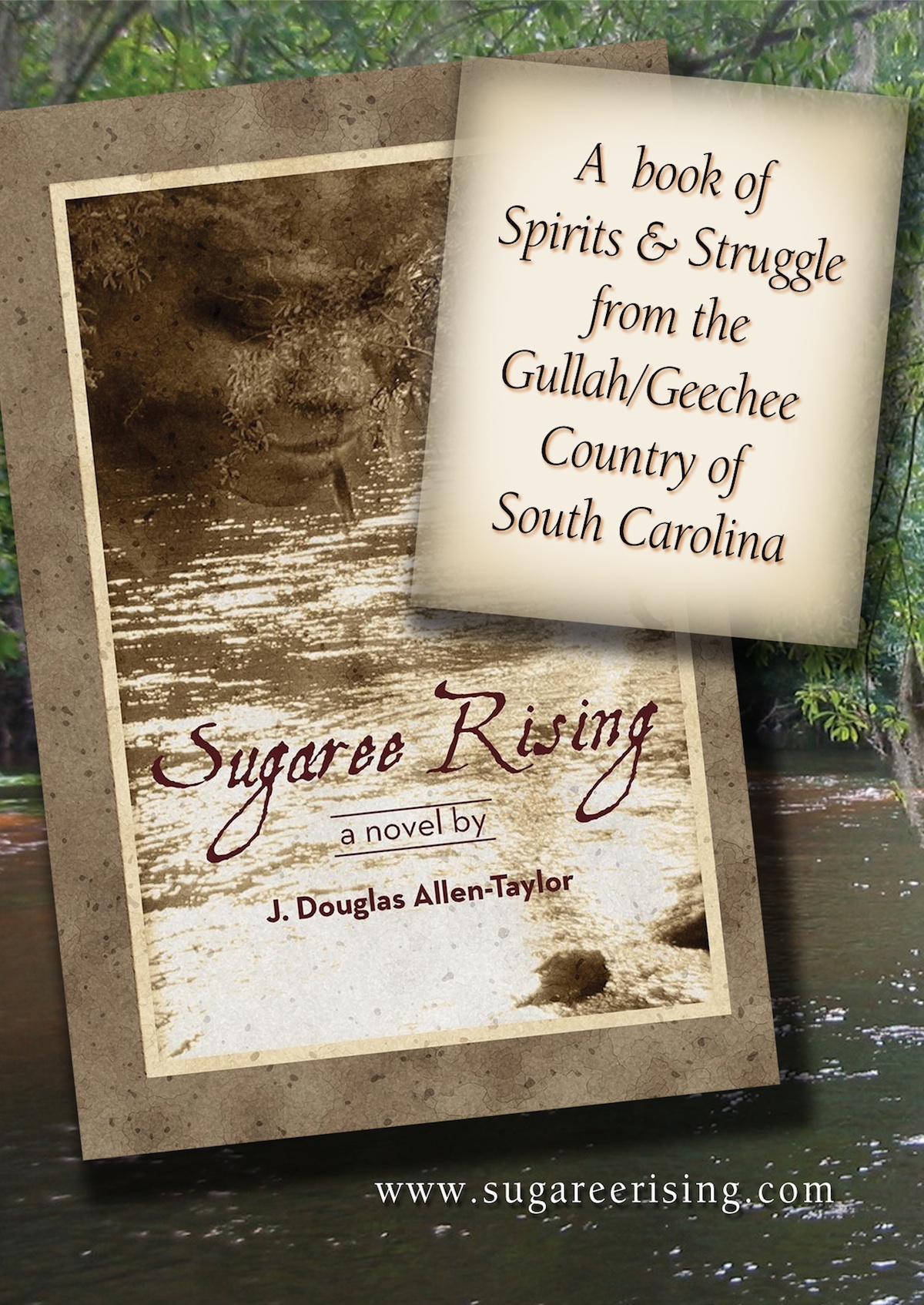
Independent San Francisco Bay Area publishers Freedom Voices announced this week the acquisition of publishing rights for “Sugaree Rising,” Bay Area author, journalist, and political columnist J. Douglas Allen-Taylor’s first novel.

A publication date has not yet been set, but is expected sometime in late 2012.

Set in the South Carolina coastal area Lowcountry in the late Depression years, “Sugaree Rising” is the story of community resistance to a massive community relocation forced by a Tennessee Valley Authority (TVA)-style dam building and rural electrification project. The novel also details the struggles of a unique group of Lowcountry African-American people—commonly known as “the Gullah”—to maintain a religion and culture largely based in their ancestral African homeland.

Allen-Taylor’s novel is loosely based upon the Santee Cooper Project, the 1930’s era initiative that carved out two major lakes in the heart of South Carolina, brought electrification to scores of rural communities, but in the process dislocated more than 900 families, most of them African-American.

Freedom Voices editor B. Jesse Clarke calls “Sugaree Rising” “a very solid piece of work. The characterizations and the evocation of place and time are consistent, intelligent and well paced. The weave between spirit and practicality is nearly seamless. Mr. Allen-Taylor certainly had a wide range of publishing choices for such a quality novel. We’re very happy that he has chosen to publish with Freedom Voices.”

Because Allen-Taylor’s novel crosses several established genres, Freedom Voices expects “Sugaree Rising” to have success in the African-American, women’s, historical fiction, literary fiction, and Southern fiction markets. [More...]

.


FROM AN EARLY REVIEW OF J. DOUGLAS ALLEN-TAYLOR'S NEW NOVEL, "SUGAREE RISING":

“Set in 1935-36, the background drama of the story is drawn from a real event, the building of the Santee River Dam, a New Deal project designed to control floods, provide jobs for the unemployed, and electricity to the rural areas. The novel opens with the Kinlaw family learning that their home and the homes of all their relatives on [Manigault] Hill will be flooded by the proposed construction; the graves of their ancestors covered by lakes to be enjoyed by ‘cracker’ fishermen. Having heard these rumors before, they were doubtful because they could not understand what good electricity would do anyone living underwater, and they furthermore did not think that the white ‘buckra’ would ever flood their own homes, fields, and graveyards. Rather than employ the usual dichotomies of white and black, industrial and agricultural, modern and pre-modern, Allen-Taylor's story takes an interesting twist. Buried deep among the ancillary tales of tricksters, the supernatural, and hoodoo is the unique coming of age story of protagonist Yally Kinlaw who, as she approaches the age of sixteen, is one of the most appealing young literary characters since [‘To Kill A Mockingbird’s’] Scout Finch.”

Reviewer
The University of South Carolina Press


NEW NOVEL TAKEN FROM HISTORY OF SOUTH CAROLINA'S SANTEE COOPER PROJECT RELOCATION

.

.

The late Depression-era exodus and relocation of hundreds of families by the Santee Cooper Project—a long-forgotten piece of South Carolina history—will soon be resurrected in literature.
           

Former longtime South Carolina resident J. Douglas Allen-Taylor is currently completing negotiations for the publication of his novel, “Sugaree Rising,” a fictional account loosely based on events surrounding the Santee Cooper relocation.
           

Most South Carolinians and visitors think of Santee Cooper as the popular wildlife and recreation area that covers two man-made lakes, Moultrie and Marion, and stretches through the heart of the state from the Lowcountry into the Midlands. What is not well-known is that when the massive rural electrification and defense transportation project was begun in 1939—including the building of the Pinopolis dam near Moncks Corner—some 900 families were uprooted in the process, forced to disband their communities and relocate families, homes, farms, churches, and even graveyards to surrounding areas. Many, apparently, did not go quietly or willingly, according to newspaper accounts from the time.

[More]

.

.

"AFTER FINISHING 'SUGAREE RISING,' I FOUND MYSELF STILL LIVING IN YELESAW"

"'Sugaree Rising' is a moving, profound and powerful novel. When I got to the end I felt that I had learned that there are forces in this world that are bigger and deeper than white men's greed, a timely message. Early on it seemed to be a novel about victimization, like all the other stories of eminent domain evictions and land thievery. But by the end, although that was still one of the novel's themes, the book's core somehow became something bigger. I feel the aliveness of older, deeper traditions and connections, and that knowledge somehow gave me hope.

"There were so many things I admired in this book: I loved the characters, especially Allen-Taylor's strong, feisty women. Kudos! I loved the various kinds of conflict he developed, some familiar, others new to me. I also loved the mystical/spirit levels of the book, the humor, the explorations of extended family dynamics.

"After finishing 'Sugaree Rising,' I found myself still living in Yelesaw, finding a vitality there, where every bird and blade of grass was animated. As all is everywhere, if we stop and pay attention."

-- Bay Area Novelist Elizabeth Claman (Author of "Identity Blues" and "The Prodigal Wife")


A Flood Planned.

An Evacuation Forced.

A People Dispersed.

A Community Destroyed.

Who—Or What—Can Prevent It...?


Gradually she dragged the whole story out of them. Bonk Jackson had heard it across the river at Jaeger’s Store that morning. The whitefolks were making plans to put a dam across the Sugaree River, leaving a lake in the Bottom basin between St. Paul and Cashville—the rivers, the Swamp, thousands of farmland acres, a wide collection of towns and crossroad villages, the little junction of Jaeger’s Cross, and Yelesaw itself. The enormity of it was too much for her to take in.

“Why the whitefolks want to flood all that up?” she asked, in bewilderment.

“Who know?” Dink said, sucking his teeth. "Maybe for make it easier for catch fish.”

-- From "Sugaree Rising"
A New Novel By J. Douglas Allen-Taylor


Oakland Columnist Wrapping Up Work On First Novel

Oakland Local
July 14, 2011
By Pamela Drake

[NOTE: There are two small, factual errors in this article. I worked for the Southern Christian Leadership Conference in 1980, not in 1969. And the article should have noted that Berkeley County, South Carolina, was the only Southern county I ever visited that did not have a Confederate statue, not the only Southern county that did not have one. There may be others. -- J. Douglas Allen-Taylor]

One local writer, journalist and chronicler of Oakland’s political scene and beyond, has written a novel set in South Carolina in the late 1930s.

Known to many of us simply as Jesse, J. Douglas Allen Taylor is a native Oaklander whose family has deep roots in the Bay Area. I asked him why the book was set in South Carolina.

“Half of my adult life was spent in the South,” he replied.

He first took a job with the Southern Christian Leadership Conference in 1969 and stayed on for two decades. He was a full time Freedom Worker and community organizer in the Movement while writing for an African-American newspaper. During this period he heard the stories of African-Americans who had survived generations of oppression and upheaval in the South.

One day he asked an elderly man where he was from and the man pointed to a nearby lake, “over there,” he said. Taylor asked him what he meant, “was there an island in that lake once upon a time?” The man told him that his home, his neighbors, his town had once existed in the lake’s depths before the area had been flooded. It had taken place during the Works Progress Administration as a rural electrification program, the Santee-Cooper Power Project.

[To Complete Article]


EVERY GOODBYE AIN'T GONE...

We live in a world where many people believe Death is the ending of Life

And when the government orders you out, you best get up and go

And then there are others who are of another mind...

...Sugaree Rising


The Crossroads
A reading from the novel "Sugaree Rising"


Literary Fiction
Historical Fiction
African-American Spirit Naturalism


THE MAN WHAT COME LOOKING FOR ORRY

"He made his slow way up the aisle to the deep thud of his walking stick and the scrape of his boots and the blowing out of his breath, the steam coming off him like a plowmule, the stormwater running from his hat and coat in long dripping streams, the smell of mildewed tobacco and black bait-earth and wet leaves and mule-rank all about him, step after wobbled step, dragging his broke-up legs with him, holding out his free arm for balance, sometimes reaching forward to grasp the edge of a bench-back when it seemed for sure he might lose his balance and tumble forward. No-one in the Sambuhouse said a word. A hundred wide stares followed his slow progress while he himself was looking not left neither right, but eyes steady down, as if he thought the floorboards themselves were going to reach up and slap him on the forehead if he didn't pay them proper attention."

-- From "Sugaree Rising"


Lam'Jackson Comes Calling On The Kinlaws
A reading from the novel "Sugaree Rising"


A story of Loss and Identity.

A story taken from actual events...


CLEARING AND RESETTLEMENT

From "Fifty Years: The History Of Santee Cooper"
By Walter B. Edgar


Map Of The Santee Cooper Lakes Following The Building Of The Pinopolis Dam, The Story That Inspired "Sugaree Rising"


Connect with "Sugaree Rising" on Facebook

For more information about J. Douglas Allen-Taylor
go to www.safero.org
or contact Mr. Allen-Taylor at safero@earthlink.net